

For decades, cursive remained a significant obstacle for automated computing systems. Despite the fact that digital fonts are easily recognized, flowing handwritten lines have long remained a complex mystery. At the same time, AI Consulting & Development Services are now becoming more accessible, which opens up opportunities for development in many directions. Answering the question can AI read cursive, you can give an affirmative answer. Modern artificial intelligence algorithms have learned to convert even the most complex writing into structured data that is easily recognized by any electronic system.
Key points
Understanding How AI Reads Handwriting
Deciphering human handwriting is a complex process that is different from simply interpreting a printed book. In conventional typing on a computer or phone, each letter is a standardized set of pixels that are easily recognized.
When a person writes by hand, each letter is a unique emotional expression, influenced by speed, surface, and mood. Modern systems do not simply try to recognize ink on paper, but interpret each stroke, which poses some difficulties.
What Is Handwriting Recognition Technology
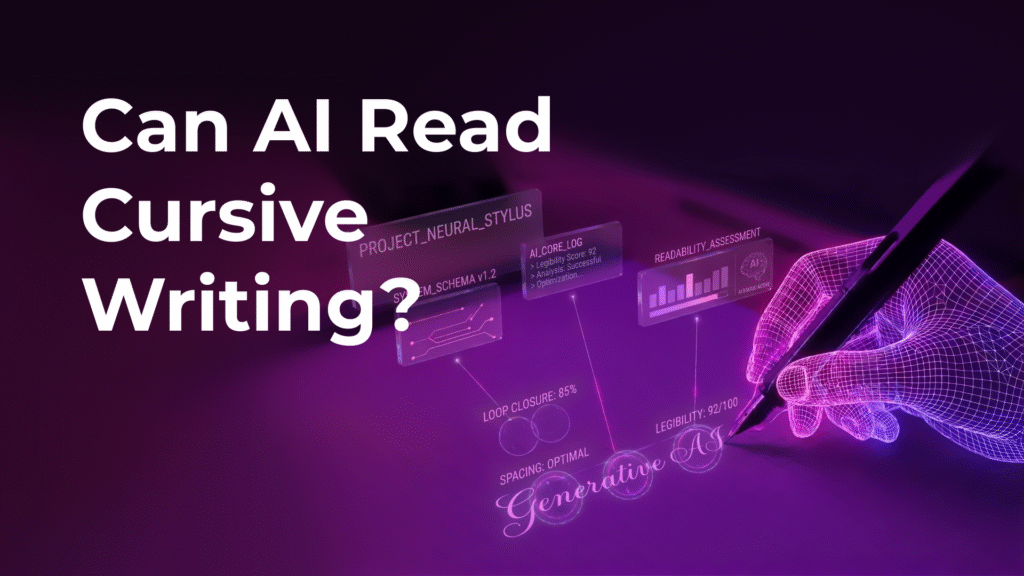
Handwriting recognition (HTR) is a modern technology that has evolved from simple pattern matching. Unlike older systems, newer HTRs use Vision Transformers (ViTs) to analyze entire text sequences simultaneously. This allows the AI to understand a complete sentence, rather than trying to figure out just one character.
Differences Between Printed and Cursive Text
The main problem in analyzing cursive is the lack of space between letters. In printed text, letters stand alone, so they can be easily segmented and interpreted using digital computing capabilities. Italics has its own characteristics. It is a continuous series of letters, where the end of one letter is the beginning of the next, which creates difficulties in the operation of standard algorithmic systems.
Can AI Actually Read Cursive Writing
The natural question arises: can AI read cursive writing? The answer is yes, but the accuracy varies depending on the handwriting and the characteristics of the chosen algorithm. High-end artificial intelligence models achieve an accuracy of over 95% on readable cursive. However, the results vary depending on the characteristics of the source material, so they may differ.
Common Challenges with Cursive Handwriting
Despite the great development of modern technological solutions and approaches to analysis, cursive remains a problem when digitizing documents. The instability and flexibility of writing mean that context is the only primary way to recognize letter combinations. In this case, specific algorithms for analysis must be used. Among other factors that affect the recognition of cursive writing:
- Ligature ambiguity. Characters such as u, n, m can look the same if written quickly, which causes recognition difficulties.
- Tilt and pressure. The angle of the pen and the pressure applied affect the final geometry of the letter, so AI cannot always recognize what is written.
- Base drifts. Human handwriting often has certain tonalities, which is why artificial intelligence cannot always recognize what is written unambiguously.
Modern algorithms rely on visual cues and speech probability to guess the most likely word. For example, if there are similar letters nearby, AI looks at the next ones to better understand the context. That is why the analysis result may be inaccurate.
Technologies Behind Cursive Recognition
The recognition technology is based on a complex neural architecture. Currently, it is not necessary for the AI to constantly show a template for a particular letter. Now it is enough to provide ready-made libraries of templates for training, which will help analyze cursive handwritten text.
Machine Learning and Neural Networks
To recognize human cursive text, modern systems use convolutional recurrent neural networks (CRNN). The convolution is responsible for visual features (loops and lines). The repetition part uses LSTM or GRU layers and manages the sequence, ensuring that the data is remembered.
Thus, the artificial intelligence algorithm understands the context in which the narrative is located in the text. In a formal sense, artificial intelligence calculates the probability of a string of image characters using complex mathematical functions and transformations.
Role of Optical Character Recognition (OCR)
OCR is the key principle that provides basic vision. Large language models act as the brain to correct errors in real time as the text is scanned. When OCR sees handwritten text, the integrated model instantly corrects any errors based on training on billions of pages of text.
Limitations of AI in Reading Cursive
Artificial intelligence has not yet reached 100% and is unlikely to ever reach it. Algorithms have certain limitations due to the many stylistic exceptions and peculiarities of a particular person’s writing. In addition, there are linguistic and contextual challenges.
Variability in Human Handwriting Styles
There is no standard cursive style. There are thousands of variations that vary from person to person. It is these small differences that reduce the accuracy of recognition of written text.
| Script Type | Average AI Accuracy (2026) | Primary Difficulty |
| Palmer Method (Classic) | 97% | Highly standardized, easy for AI to learn. |
| Modern Personal Cursive | 88% | High variability and idiosyncratic shortcuts. |
| Historical Manuscripts | 72% | Ink bleed, non-standard spelling, and paper decay. |
The data shows that complex handwriting remains a challenge for AI. Several learning models are currently being tested so that AI can adapt to a person’s unique style after seeing just a few sentences of their text.
Language and Context Challenges
Recognition results also depend on the language and vocabulary. For example, medical and legal slang have certain abbreviations that are not found in standard AI training materials. This makes it difficult to interpret italics.
Conclusion

The question of can AI read cursive handwriting is still open. Artificial intelligence is already actively used to analyze handwritten text. Engineers are constantly working on improving algorithms to increase the recognition rate to 100%. While this process is ongoing.