

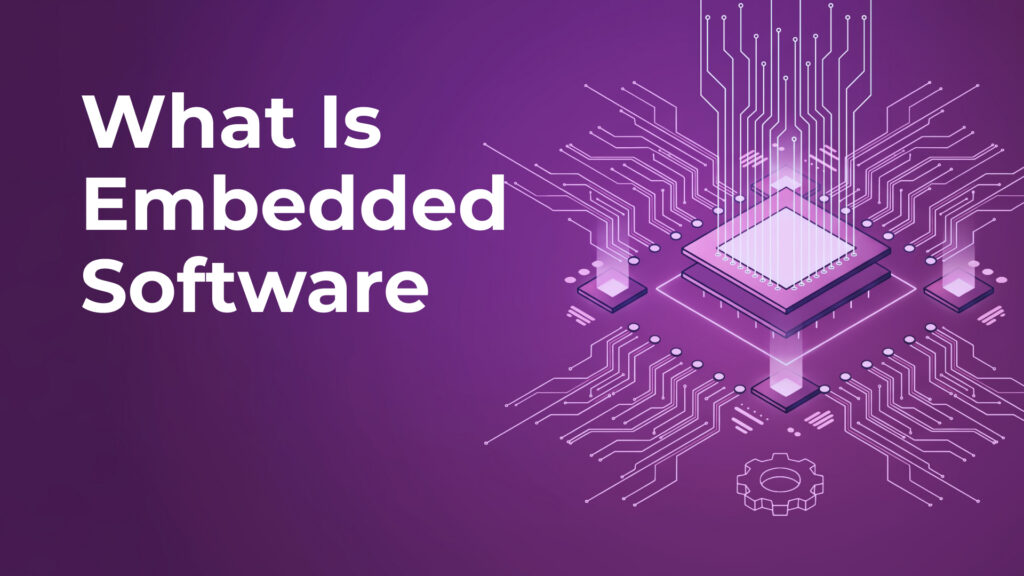
Embedded software is the code that controls devices. It runs inside machines, vehicles, industrial systems, and consumer electronics, telling the hardware what to do and when. Unlike normal software on a computer or phone, it is designed specifically for the device it runs on. It often works alongside operating systems and low-level drivers for better performance. Embedded software allows devices to operate reliably and connect with other systems. Today, we’ll learn more about what is embedded software.
Key points
Definition of Embedded Software
Embedded software is the code built into a device from the moment it leaves the factory. It is purpose-built, hardware-specific and runs in the background of nearly everything around us.
It’s not like the programs you open on your computer or phone. It doesn’t let you choose what to run, and it doesn’t work for different tasks. It has one job: to control the device and make sure it’s working properly.
Cars, CNC machines, medical monitors, and various sensors all operate thanks to embedded software. It receives signals, processes them, and sends them on. Thanks to it, all the parts of the device work together and don’t malfunction.
Thus, Soloway.Tech provides embedded software development as part of the full-cycle engineering solutions. We focus on building scalable IT architectures and sustainable systems. Soloway ensures the software is reliable and tailored to business requirements while integrating with existing infrastructure.
How Embedded Software Works
Embedded software works directly with the components of the device and controls how they work. It is stored in memory that is not erased after power-off, such as flash memory or ROM. It is written in simple languages such as C or C++ to precisely control every part of the device.
This software constantly listens to signals from sensors and reacts immediately. It does not stop: it checks the status of the system, performs its tasks and ensures that resources are used correctly.
Then it takes data, processes it according to specified rules and launches the necessary actions without delay. For example, it reads data from a sensor, changes the settings of mechanisms and transmits information to other devices via a network. In complex systems, this helps the equipment to work stably and without errors.
There are several levels in embedded software, and each is responsible for its own part of the work:
- The lowest level (hardware abstraction) works with the hardware. It manages memory, processes signals from buttons or sensors, and is responsible for data exchange.
- The middle level takes data, checks it, and puts it in the desired form. It also makes sure that everything works according to the rules of the system.
- The upper level performs the main task of the device. This is where it is decided what exactly the device should do in response to the data received.
Thanks to this structure, the software works stably and can be updated or connected to other systems without any problems.
Common Devices That Use Embedded Software
Embedded software appears in many devices that people use every day. It is built into the device and stays focused on one job. The device type decides how the software works and how fast it must respond. These are the examples:
- Real-time devices must respond instantly and predictably. Hard real-time systems, like airplane flight control systems or anti-lock brakes in cars, cannot afford to miss their response time. Soft systems, like digital audio players or video streaming devices, can delay processing for a while without any problems.
- Autonomous devices operate independently, without being connected to other systems. For example, microwave ovens, washing machines, or digital thermometers.
- Networked devices communicate with other systems using protocols like Ethernet, Modbus, CAN, MQTT, or EtherNet/IP. Common examples are industrial PLCs, ATM machines, security cameras, and IoT gateways.
These examples show how embedded software helps devices manage processes, process data, and stay connected.
Key Characteristics of Embedded Software
Embedded software shares common features regardless of the type of system it runs on:
- It is designed for one task and performs it continuously without stopping.
- At the same time, it works stably and without errors. It uses limited resources: memory, power and energy, so everything must be calculated accurately.
- Such software works predictably. This is especially important where each action must be performed on time.
- It also has clear interfaces and APIs so that it can be connected to other systems and updated without problems.
- It’s designed for long-term operation. It can withstand difficult conditions, such as temperature changes, vibrations or interference.
This is why such software is needed in both simple devices and complex systems.
Why Embedded Software Is Important

Embedded software is the foundation that makes modern intelligent devices possible. It controls everything from everyday consumer products to critical infrastructure: cars, medical equipment, power systems, airplanes, and industrial machinery.
The global embedded software market size is projected to reach USD 30.23 billion by 2030, growing at a CAGR of 9.5% from 2025 to 2030. This growth shows the increasing demand for connected and autonomous devices across all industries. For businesses, it means a need for machines to work together, data to come in immediately, and equipment that doesn’t fail. And for this, the software must be accurate and easily connect to other systems.
When such a need arises, companies turn to Soloway.Tech. They have over 17 years of experience and more than 1,500 completed projects. The team takes on everything: understands the task, creates a solution, launches it and supports it further. You don’t need to look for several contractors, everything is done in one place.