

The digital product market today is so overloaded with information that data itself has long ceased to be an asset. When opening an app or website, users instantly evaluate the service’s sophistication. If the recommendations offered don’t match their needs, or the search results contain irrelevant information, their trust in the site diminishes within seconds. Imperfect website architecture and poor data processing lead to a drop in key metrics and increased audience churn. To minimize the gap between mechanical information collection and the creation of a valuable digital product, website developers employ sophisticated processing methods.
At this stage, technology plays a key role, changing the principles of working with information and transforming disparate datasets into a structured resource. AI Consulting & Development Services focus not only on storing significant volumes of text but also on its deep interpretation. In such conditions, AI scraping serves as the connecting link, enabling software to analyze the context of information found online and accurately present it to the end user.
Key points
Definition of AI Scraping
When exploring what is AI scraping, it is essential to view this technology as a logical step in the evolution of traditional parsing, where rigid algorithms are replaced by the inherent flexibility of neural networks. Traditional scripts stop working correctly with the slightest change to a website’s layout. AI, on the other hand, can recognize context, determine the meaning of headings, and identify data types, even when their location on the page changes.
With this approach, the developer is freed from the need to constantly adjust code for each new source. Their task shifts to configuring models capable of self-learning and adapting to unstructured data sets. In this case, businesses receive a clean sample suitable for instant analysis. This provides a competitive advantage in a market where many participants still rely on disparate and unprocessed data.
How AI Scraping Works
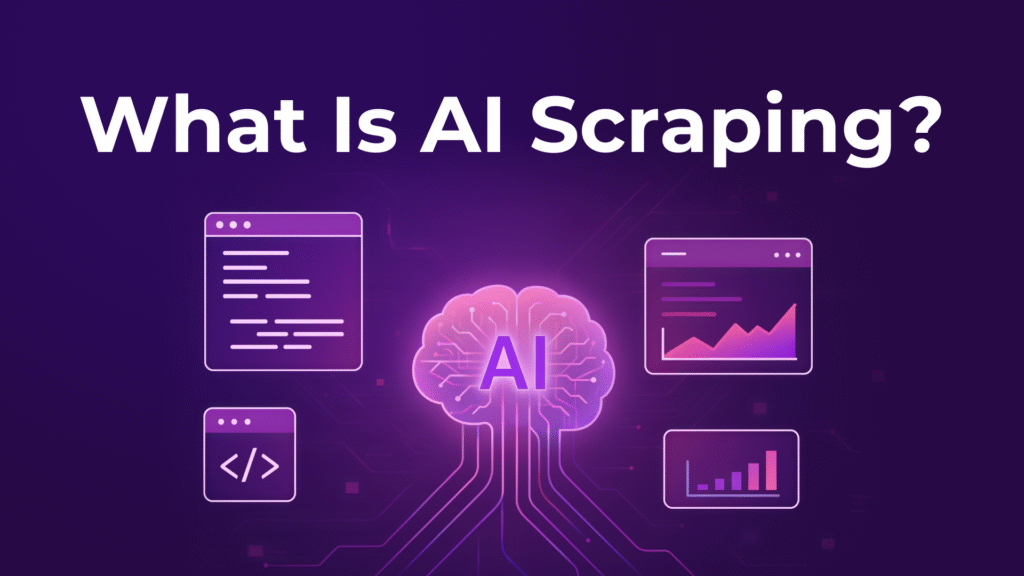
The operation of this technology can be thought of as multi-level filtering. First, the source content is captured, then it is cleaned of redundant technical elements and subjected to semantic analysis. The system doesn’t simply duplicate characters, it identifies significant elements and establishes connections between them.
The differences between traditional and AI scraping become apparent at several stages:
- Automated navigation through complex interfaces enables the system to mimic human actions and overcome technical access limitations, which is critical to product stability.
- Processing unstructured data transforms disparate information from multiple sources into a unified format that is easy to store.
- The use of ML models enables the determination of the context of information, enabling businesses to gain insight into their customers’ true preferences.
- Dynamic adaptation to source changes eliminates the need for manual developer intervention when updating the structure of third-party web pages.
This makes digital products more efficient for users, easier for developers to manage, and more profitable for the company.
Common Uses of AI Scraping
Looking at practical applications where users experience its results, the use of AI for data collection is evident in the following scenarios:
- Content personalization. News feeds adapt to audience interests, reducing search time and increasing the effectiveness of business advertising models.
- Recommender systems in retail. Algorithms analyze market offers and current trends, providing users with relevant options in real time.
- Price monitoring. Automated data collection enables companies to respond quickly to market changes while maintaining profit margins.
- Review and feedback analytics. Developers receive structured reports on technical errors, while businesses receive an objective picture of product quality.
- Intelligent news aggregators. Data collection from hundreds of sources creates a comprehensive information picture for the user without duplication.
- Competitive analysis. Companies gain the ability to track changes in competitor strategies based on deeply processed data from open sources.
This type of implementation makes AI scraping a must-have in the modern industry. Without these tools, a digital product loses its ability to meet dynamic market demands.
Legal and Ethical Considerations
The development of intelligent data collection technologies requires compliance with legal and ethical standards. Large-scale data processing requires consideration of risks associated with privacy and copyright protection.
To summarize, the key risks typically boil down to the following aspects:
- Collecting personal data without proper notification can lead to a breach of privacy and a decrease in brand trust.
- Ignoring web resource usage rules can lead to technical blocking and make it difficult to operate the service.
- The possibility of information distortion during automated analysis can lead to erroneous conclusions and compromise the project’s financial stability.
- Heavy reliance on external platforms makes the system sensitive to changes in third-party data access policies.
In these circumstances, finding a balance between collection efficiency and adherence to ethical standards is a priority. Responsibility for the correct use of this technology rests entirely with developers and business owners.
Conclusion

AI scraping today is not just a technical tool, it is a fundamental foundation for the functioning of the modern internet. This technology transforms fragmented data into meaningful experiences valued for their accuracy and efficiency. Despite the complexity of implementation and legal challenges, the demand for data interpretation tools will increase in the near future.
For users, it means less friction and better guesses from services, for developers, a move toward intelligent systems, for businesses, a way to stay relevant.