

Today, having an enterprise CRM is critical for the manufacturing sector. Managing sales processes to align with the customer’s buying journey is increasingly complex but essential for growing business. This article explores a curated list of manufacturing CRM systems equipped with open APIs and how our SoloWay Tech team can help you with your enterprise.
Key points
What is CRM for manufacturing?
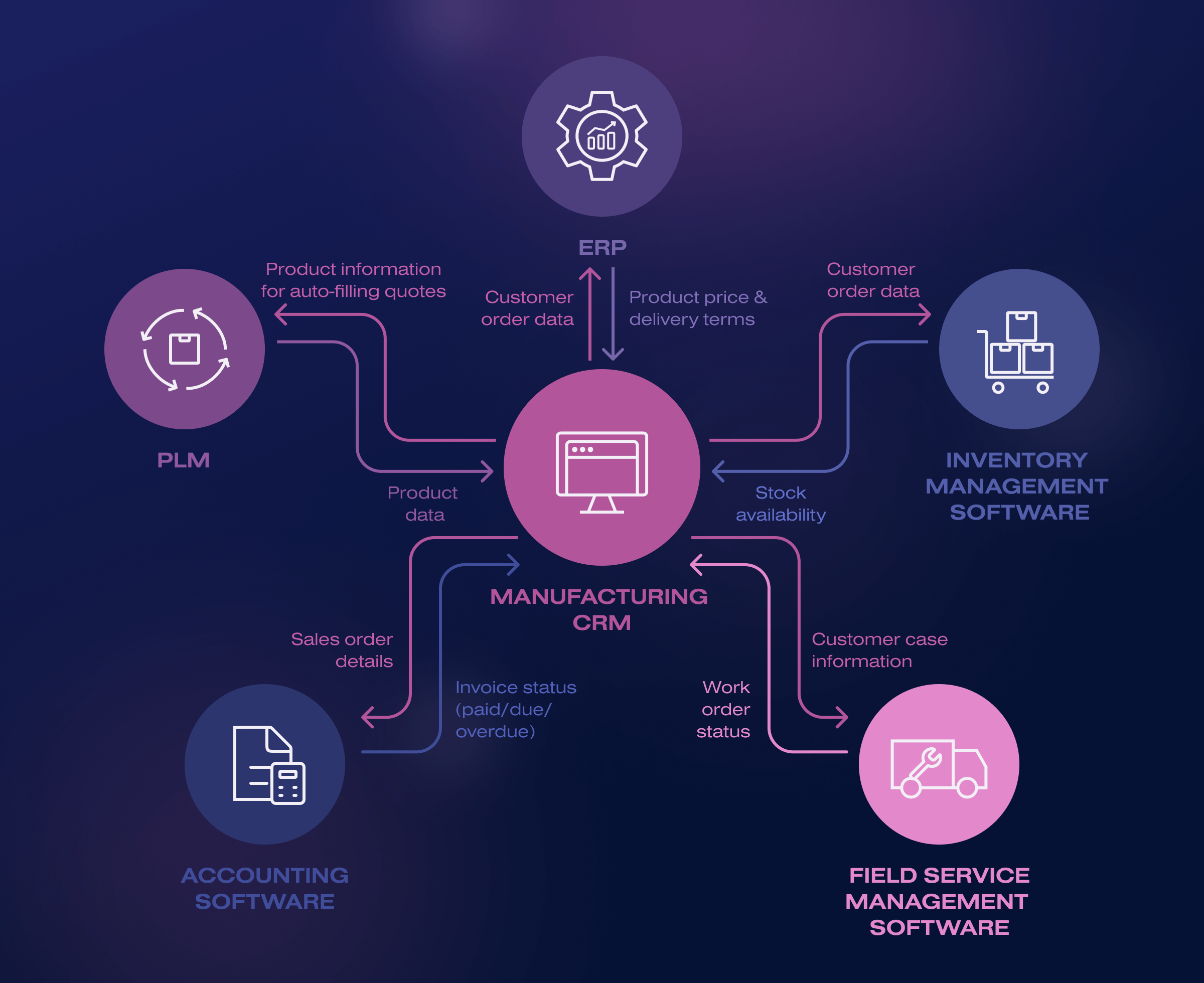
CRM for manufacturing is a strategic approach that helps organizations build stronger customer relationships, streamline business processes, and improve their market competitiveness. It enables manufacturers to understand customer needs better, enhance communication across the supply chain, and deliver products and services more efficiently.
Manufacturing CRM development is a much more comprehensive process than the CRM development for financial advisors.
Must-Have Manufacturing CRM Features
CRM functionality for production and sales can be very different. It all depends on the company’s needs, the tasks set, and the peculiarities of the enterprise. But in most cases, a mandatory set of functions needs to be implemented.
Automation of sales business processes
Production increases turnover and sales if the company can automate business processes. How does a CRM system for manufacturing help in this?
Tools for working with customers allow you to immediately accept an application from different sources and direct it to a free manager or a specialist who has already worked with this client. Then, the client profile is opened, where all the data about him or her is collected, and the time for execution of documents is reduced.
Routine tasks are automated, and work is reduced to a minimum of actions. As a result, sales are made faster, work with the client is of higher quality, and the probability of errors is significantly reduced.
Sales management
Control sales, monitor stock balances in real-time, and see which products are more in demand. CRM for a manufacturing company allows you to fully control and manage sales, make plans, and evaluate the effectiveness of the enterprise.
Product catalog
All production products are collected in a single catalog. Data on the balance, cost, and other parameters are constantly updated. There is a possibility of different catalog displays for different categories of users. A specific cost can be reflected for customers and for partners – another.
Processing of orders with the help of the catalog is also accelerated and becomes more informative. The probability of errors is reduced. Now, there is no possibility to choose the wrong color or product that the customer needs.
Relationship management with customers, partners, and suppliers
Thanks to communication tools, CRM for manufacturing allows you to communicate comfortably with customers, partners, suppliers, and distributors. These are not just chat rooms where it is convenient to communicate. These are separate databases, profiles that save communication history, and comfortable and secure workflow. These tools allow you to manage relationships within the company and with the outside world.
Order fulfillment control
All orders have their status. Notifications come if the order is not fulfilled, not ready for shipment, or, on the contrary, realized. Thanks to this, errors in the work of managers in order processing are excluded.
Marketing automation
Data collection and analytics allow marketing strategies to be automated and improved. Company owners can see the efficiency of employees, traffic sources, points of loss of funds, and the demand for positions. This enables marketing strategies, improving the company’s positioning and attracting even more customers.
List of Manufacturing CRM Systems with Open APIs
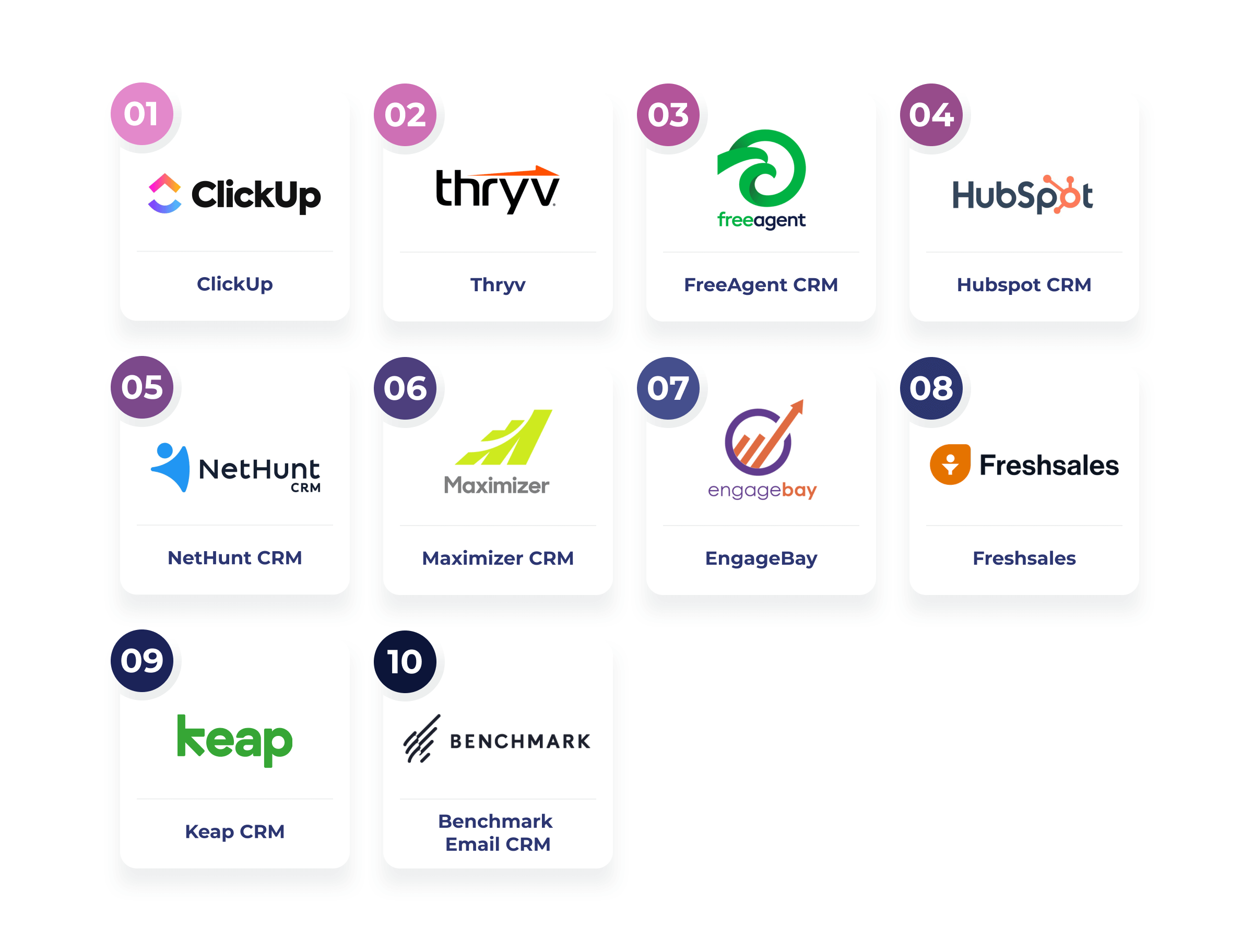
The best way for any manufacturer to save money on custom CRM development is to use SaaS CRM systems with open APIs. They can have unnecessary functionality and be less cost-effective in the long term than custom CRM, but they help save money in the short term. Here is the list of 10 best manufacturing CRM systems with open APIs:
- ClickUp
- Thryv
- FreeAgent CRM
- Hubspot CRM
- NetHunt CRM
- Maximizer CRM
- EngageBay
- Freshsales
- Keap CRM
- Benchmark Email CRM
By embracing the power of open APIs in CRM, manufacturing enterprises can not only meet the challenges of today but also position themselves for sustained growth and competitiveness in the future.
If you are looking for a reliable IT partner that can assist you with your CRM development or integration, we are your best choice. Explore our case studies to find more expertise our SoloWay Tech team has.
Manufacturing CRM Integration: How Can SoloWay Tech Help You Improve Customer Service with a CRM that Fits Your Business?

Integrating two systems means making sure that they communicate with each other effectively and in real-time. Manufacturing CRM integration involves combining data from the marketing automation platform (HubSpot, for example) with the existing CRM system and vice versa.
The continuous exchange of data between the two systems allows the sales force to continue the actions taken by marketing successfully. Especially in a complex industry like manufacturing, seamless integration can bring excellent results for several reasons:
- Many B2B companies have a limited number of contacts compared to the B2C world
- Value of a single contract can determine the achievement of revenue goals
- Frequent repeat purchases occur
- Multiple decision-makers and influencers are present in the purchasing process
Each CRM integration process is unique, and it is difficult to define the time required to plan, map, and complete all the steps. However, as a rule, an effective process takes about 8 weeks from initiation to completion.
What are the steps of integrating CRM for manufacturing? Here are them below.
Definition Phase
This first phase aims to set the project’s parameters and understand what elements and data must be shared between the two systems. As in any strategy, setting the objectives and evaluation criteria is crucial to the action plan’s success.
Design Phase
After a review of data and objectives, the second phase is used to identify and design workflows. Are there limits on the frequency of communication between systems? Will data be transmitted in real-time?
During the phase, additional specifications may be added to the design. For proper mapping to occur, creating and synchronizing specific fields in the two systems may be necessary.
It is also important to define an internal quality control process to test the integration before starting it outright. The testing and verification phase is as important as the design itself.
Construction Phase
Once the design phase is completed, we move on to the actual concretization. The integration will be built based on the specifications described above. Several quality control tests will be run, and then we will move on to implementation.
All elements must be precisely defined for the construction phase to be effective. For example, when can a product be considered sold?
The alternatives are:
- When does the customer place the order?
- When are the goods shipped?
- When is payment concluded?
- When will the customer receive the order?
Having a shared language ensures that data flow from one system to another is seamless and problematic misalignments do not occur.
Test Phase
All necessary quality tests are performed in a controlled development environment in this phase. Doing so makes it possible to verify that all data and mappings are correct and resolve any problems before implementation.
Implementation Phase
The last step in the process is the formal initiation of integration. This is the moment when:
- Data synchronization is initiated
- Workflows are activated
- You verify that the transfer is completed without errors
- You have the opportunity to intervene in case of unforeseen events
The advice at this stage is not to start the integration at the end of the month (or quarter). It would be better to embark on this new path and data exchange at a time of lower impact for the various business departments.
Conclusion
Our SoloWay Tech team comprises renowned software developers from Ukraine with experience in over 10 industries. We worked with projects in the following industries: financial services, eCommerce, manufacturing, eLearning, real estate, hospitality, and more. If you need help with developing custom CRM or integrating SaaS CRM using open APIs, we are ready to help you.